
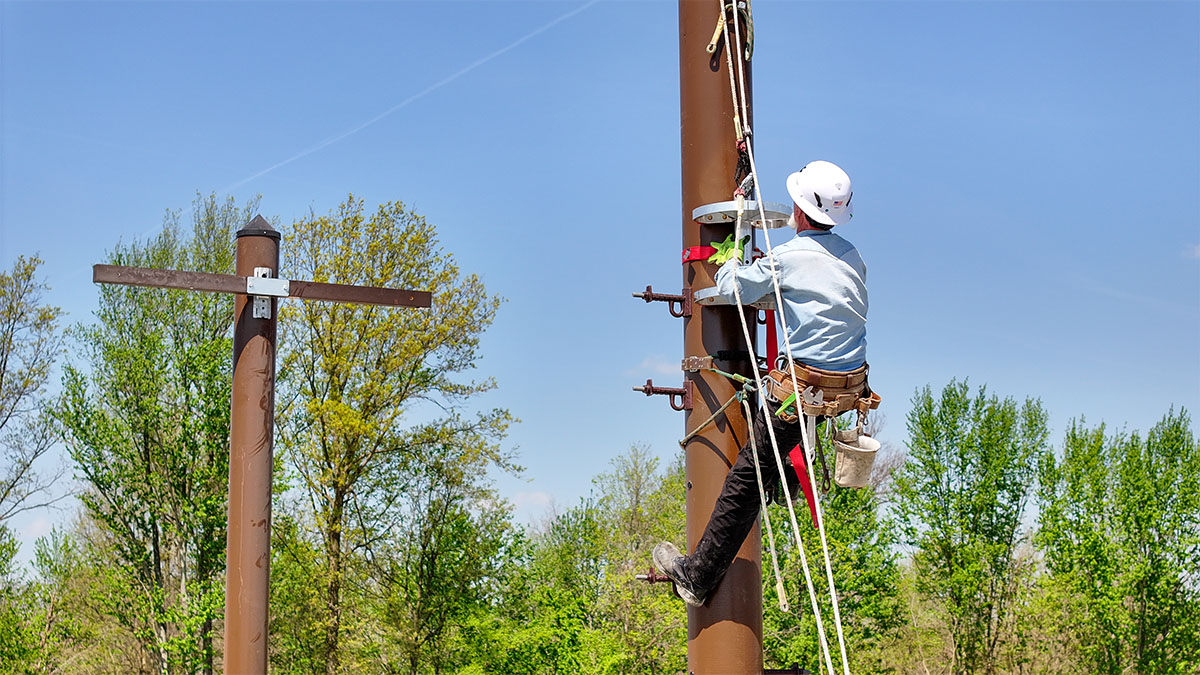
How long utility poles last depends partly on the material and partly on what happens to the pole over decades in service. Wood pole service life can vary considerably with inspection and maintenance, while other materials have their own aging mechanisms and service-life considerations. A 2021 Oak Ridge National Laboratory assessment lists 60 years as the expected service life for galvanized steel poles and 70 to 100 years for composite poles.
Published lifespan figures do not always represent the same thing. Some come from field averages, others are planning assumptions or expected service-life ranges, and some depend heavily on inspection and maintenance. A useful utility pole material comparison looks at what supports each number, not just which one is highest.
How Long Do Utility Poles Last by Material?
Wood Utility Pole Lifespan
The U.S. Department of Energy’s Utility Pole Maintenance and Upgrades Resilience Investment Guide estimates the average service life of wood utility poles at 30–50 years, with considerable variation based on inspection, maintenance, and replacement practices.
Species, preservative performance, moisture, biological damage, fire, loading, and local environmental conditions can also affect how quickly a wood pole deteriorates.
Steel Utility Pole Lifespan
With steel poles, service life depends heavily on corrosion protection and exposure. The 2021 ORNL assessment lists a 60-year expected service life for galvanized steel poles.
The American Galvanizers Association reports that hot-dip galvanized steel can remain in service for more than 70 years under certain conditions. Coastal salts, industrial exposure, soil chemistry, standing water, and coating damage can all change the corrosion rate. How long a steel pole lasts depends on the protection system and the environment where it is installed.
Fiberglass Composite Utility Pole Lifespan
Composite poles age differently because they do not decay like wood or corrode like steel. UV stability, weathering, material design, and manufacturing quality become more important to long-term performance. The ORNL assessment lists a 70-to-100-year expected service-life range for composite poles and notes that performance depends on manufacturing.
Early composite installations show why UV resistance matters. Fiber-reinforced composite poles installed on Maui in the early 1960s remained in service for approximately 45 years before UV degradation caused the surface fibers to fray, according to a 2021 Oak Ridge National Laboratory assessment. ORNL notes that newer resin systems resist UV degradation and that composites have low water absorption in addition to resisting rot and corrosion.
Modern composite poles do not have the same decades of field history as wood or steel. ORNL identifies gaps in available data on aging, degradation, and inspection practices, making the design and testing behind a specific composite pole important when evaluating its projected service life.
Thursday Poles specifies an 80-plus-year lifecycle for EnduraPOLE™. Its pultruded FRP system combines corrosion-resistant ECR glass with UV-resistant materials and does not depend on decay treatment or corrosion protection to preserve the underlying structure.
Wood vs. Steel vs. Composite Utility Poles
| Material | Published Service-Life Figure | What the Figure Represents | Primary Service-Life Dependency |
|---|---|---|---|
| Wood | About 50 years average; 96 years with regular inspection and maintenance | Field average and maintenance-supported estimate | Preservative performance, environment, inspection, and remediation |
| Steel Galvanized | 60 years expected service life in the 2021 ORNL assessment; more than 70 years under certain conditions | Expected service life and general galvanizing guidance | Coating system, atmospheric and soil exposure, and coating condition |
| Composite Fiberglass | 70 to 100 years; 80-plus years for EnduraPOLE™ | Category-level expected range and product-specific lifecycle | Resin system, UV protection, manufacturing, installation, and exposure |
What Should Utilities Compare Beyond the Lifespan Number?
Before relying on a lifespan number, utilities need to know what went into it:
- Does the figure represent observed field performance, a planning assumption, or an expected service-life range?
- What climate, soil, loading, and exposure conditions does it reflect?
- What inspection, treatment, or corrosion-protection program supports it?
- What is most likely to shorten the pole’s service life?
A wood lifespan that assumes regular remediation is different from one that does not require decay treatment. A galvanized steel estimate developed for one corrosion environment may not apply in another. Composite lifespan estimates should be considered alongside the material system, testing, manufacturing, and available field history.
Utilities also need to consider how each material will age in their environment and what inspection, maintenance, or remediation it may require over time.
Evaluate the Data Behind EnduraPOLE™
EnduraPOLE™ uses corrosion-resistant ECR glass, UV-resistant materials, and a pultruded FRP structure designed for long-term utility service. Utilities evaluating its 80-plus-year lifecycle can review the technical data behind the pole against their own loading requirements and operating conditions.
Review the EnduraPOLE™ technical documents on the Thursday Poles Resources page or speak with Thursday Poles about how EnduraPOLE™ fits your system.
Frequently Asked Questions About Utility Pole Lifespan
How Does the 96-Year Wood Figure Compare With an 80-Plus-Year Composite Lifecycle?
The 96-year wood figure assumes regular inspection and remediation throughout the pole’s service life. EnduraPOLE™’s 80-plus-year lifecycle is based on a composite system designed to resist rot, corrosion, and UV degradation. The wood figure depends on an ongoing maintenance program, while the EnduraPOLE™ figure depends on the material system itself.
What Evidence Supports Composite Utility Pole Lifespan Estimates?
Long-term durability is evaluated through field performance and material testing. The ORNL assessment identifies xenon-arc and fluorescent-UVA accelerated weathering tests for evaluating weatherability and UV stability, along with flexural strength, flexural modulus, and interlaminar shear testing for measuring retained mechanical properties.
Accelerated testing helps show how composite materials respond to aging and weathering. Utilities can consider those results alongside the pole’s material design, manufacturer data, and available field history when evaluating whether its projected service life fits their system.